Can Hip Arthritis Be Treated Without Surgery?
Being told you have hip arthritis can be unsettling. Suddenly, every ache feels more significant, and you may start wondering whether surgery is inevitable.
Perhaps walking has become uncomfortable, your hip feels stiff after sitting, or you struggle to put on your shoes. Maybe you've already started avoiding activities you used to enjoy because you're worried about making the arthritis worse.
But here's something important: a diagnosis of hip osteoarthritis doesn't automatically mean you need a hip replacement.
If you're looking for hip arthritis treatment in Adelaide, there are several non-surgical options that may help manage pain, improve movement and maintain your independence.
At SA Running Injury Clinic, our physiotherapists works alongside our podiatry team to assess how your hip and lower limbs function, with treatment focused on helping you stay active and do more of the things you enjoy.
Can Hip Arthritis Really Be Managed Without Surgery?
Yes. For many people, non-surgical treatment is the recommended starting point for managing hip osteoarthritis.
Hip osteoarthritis involves changes to the joint, including cartilage, bone and surrounding tissues. Although these changes cannot currently be reversed, symptoms and physical function can often improve with appropriate management.
Exercise, education and lifestyle changes are among the most strongly recommended treatments for hip osteoarthritis.
This matters because pain can create a frustrating cycle. You move less because your hip hurts, but reduced activity can lead to weaker muscles, poorer mobility and less confidence in movement.
The right rehabilitation program aims to interrupt that cycle.
Rather than simply resting the hip, treatment focuses on helping it tolerate everyday activities more comfortably.
What Are the Early Signs of Hip Osteoarthritis?
Hip arthritis doesn't always begin with severe pain. Often, the first changes are subtle.
You might notice a deep ache around the groin, discomfort after longer walks or stiffness when standing up after sitting.
Other common symptoms include difficulty climbing stairs, reduced hip movement and pain when getting in and out of the car.
Some people also experience discomfort around the buttock or thigh. Occasionally, hip problems can contribute to pain felt around the knee.
However, not every painful hip is caused by osteoarthritis. Tendon conditions, lower-back problems and other joint conditions can produce similar symptoms.
That is why identifying the likely source of pain is an important first step.
Why Physiotherapy Is a Key Part of Hip Arthritis Treatment
One of the most effective ways to manage hip osteoarthritis is through appropriately prescribed exercise and rehabilitation.
At SA Running Injury Clinic, our physiotherapists help patients manage hip arthritis through personalised treatment plans that focus on reducing pain, improving mobility and maintaining an active lifestyle.
Rather than following a generic exercise program, our physiotherapists take the time to understand your symptoms, assess your strength and movement, and identify what you want to achieve.
For example, someone hoping to return to regular walking may need a different rehabilitation approach from someone wanting to get back to golf, cycling or the gym.
Physiotherapy for hip osteoarthritis may involve strengthening the muscles around the hip, improving joint mobility, working on balance and gradually increasing your tolerance for everyday activities.
Importantly, exercise doesn't always need to be completely pain-free to be beneficial. Some temporary discomfort may be acceptable, provided the exercises are appropriately adjusted and symptoms remain manageable.
Our goal is to help you move more comfortably, build strength and regain confidence in your body, so hip arthritis doesn't unnecessarily limit the activities you enjoy.
Is Walking Good for Hip Arthritis?
This is one of the most common questions people ask after being diagnosed with hip osteoarthritis.
In most cases, walking is beneficial when the amount and intensity are appropriate for your symptoms.
Walking helps maintain mobility, muscle function and general fitness. However, the right amount will vary between individuals.
If walking for 40 minutes consistently leaves your hip significantly more painful, it may be helpful to begin with shorter distances and gradually build up.
Cycling, swimming, water-based exercise and strengthening exercises can also provide useful ways to remain active.
A physiotherapist can help you find a suitable starting point and adjust your activity as your strength and tolerance improve.
The important thing is not to assume that movement is damaging your hip simply because you have arthritis.
Why Your Hip Pain May Not Be Coming Only From Arthritis
One of the reasons hip pain can be difficult to manage is that several structures around the hip may contribute to symptoms.
For example, gluteal tendinopathy affects the tendons around the outside of the hip. It can cause pain when lying on one side, walking uphill or climbing stairs.
This is different from pain arising primarily from osteoarthritis inside the hip joint.
Some people may have both conditions at the same time.
Other potential contributors include muscle weakness, changes in walking patterns and pain referred from the lower back.
Understanding these differences is important because the most appropriate treatment depends on the structures involved.
A thorough assessment can help determine whether symptoms are consistent with hip osteoarthritis or whether another condition may also need attention.
Can Focused Shockwave Therapy Help Hip Pain?
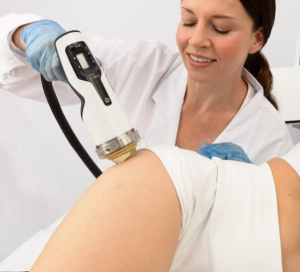
At SA Running Injury Clinic, we offer focused shockwave therapy as a treatment option for
selected musculoskeletal conditions, including certain persistent tendon problems around the hip.
However, there is an important difference between hip osteoarthritis and tendon-related pain. Conditions such as gluteal tendinopathy or greater trochanteric pain syndrome can cause significant discomfort around the outside of the hip, sometimes alongside arthritis.
For suitable patients, focused shockwave therapy may be considered to help manage persistent tendon-related pain, particularly when combined with an appropriate strengthening and rehabilitation program.
Unlike radial shockwave therapy, focused shockwave delivers acoustic energy to a more precisely targeted area at a selected depth. This can be useful when treating certain deeper structures, although it does not mean focused shockwave is necessarily more effective for every condition.
It is important to understand that shockwave therapy does not reverse hip osteoarthritis or regenerate damaged cartilage. For arthritis within the hip joint itself, exercise-based physiotherapy remains a central part of recommended treatment.
At SA Running Injury Clinic, we assess the source of your hip pain before determining whether focused shockwave therapy may be a suitable addition to your treatment plan.
How Podiatry Can Support Your Hip Arthritis Management
Your hip doesn't work in isolation.
Every step involves movement through your feet, ankles, knees and hips. When one area becomes painful, people sometimes change the way they walk without realising it.
Over time, these changes can influence comfort and function throughout the lower limb.
At SA Running Injury Clinic, our podiatrists can assess gait, footwear and foot mechanics to identify issues that may be relevant to your symptoms.
For some patients, footwear advice or treatment of a separate foot condition may help improve walking comfort.
Custom orthotics may also be considered when there is a specific foot-related reason for prescribing them. However, they are not a routine treatment for hip osteoarthritis and do not reverse arthritic joint changes.
Having physiotherapy and podiatry available within the same clinic allows us to consider both rehabilitation and lower-limb function when developing an individualised management plan.
When Is Hip Replacement Surgery Necessary?
Hip replacement surgery can be an effective treatment for people with severe hip osteoarthritis whose pain and functional limitations remain significant despite appropriate non-surgical management.
However, surgery is not automatically required simply because arthritis is visible on an X-ray.
The decision depends on several factors, including the severity of symptoms, the impact on daily life, general health and how well non-surgical treatments have worked.
For many people, a structured rehabilitation program is an important part of managing hip osteoarthritis before considering surgery.
If symptoms remain severe despite appropriate care, your GP or treating specialist can discuss whether referral for a surgical assessment is suitable.
When Should You See a Physiotherapist for Hip Arthritis?
You don't need to wait until walking becomes extremely painful before seeking help.
If hip stiffness is affecting your mornings, you're reducing your activity because of discomfort, or everyday tasks are becoming increasingly difficult, an assessment may help identify suitable treatment options.
This is particularly worthwhile if you've been diagnosed with hip osteoarthritis but haven't yet tried an individualised strengthening and rehabilitation program.
Early support can help you understand your condition, manage symptoms and work towards maintaining your mobility.
Sudden severe hip pain, an inability to bear weight, fever with a painful joint or significant pain after a fall requires prompt medical assessment.
Hip Arthritis Treatment in Adelaide: Stay Active With the Right Support
Living with hip osteoarthritis can be challenging, but it doesn't mean your active years are behind you.
Although arthritis cannot currently be cured, there are evidence-based ways to manage symptoms and improve physical function.
At SA Running Injury Clinic, our physiotherapists work alongside our experienced podiatry team to provide a broader approach to hip arthritis and related lower-limb conditions.
Whether you're hoping to walk further, return to exercise or simply move through your day more comfortably, treatment starts with understanding your symptoms and developing a plan that suits your needs.
Hip arthritis may change how you move, but it doesn't have to stop you from moving forward.