
Ankle Sprains Norwood
Treatment for Ankle Sprains Norwood
What May Contribute to Ankle Sprains?
- Did your ankle roll after landing on another person’s foot while playing sport?
- Did you twist your ankle while walking or running on an uneven surface?
- Did you hear or feel a pop around the ankle when it happened?
- Do you have ankle swelling, stiffness, or discomfort when putting weight through the foot?
Ankle sprains are a commonly seen injury presentation at SA Running Injury Clinic. They involve injury to the ligaments that support and stabilise the ankle joint and may occur when the ankle twists, rolls, or moves beyond its usual range during walking, running, or landing activities.
As mentioned above, it is caused usually by a runner or walker misjudging a step, or landing on an uneven surface. In sport, it is from changing direction or landing on another competitor’s foot.
Ankle Sprains Treatment
Ankle sprains commonly occur after an awkward step while walking or running, landing on an uneven surface, or during sporting movements such as changing direction or landing on another player’s foot.
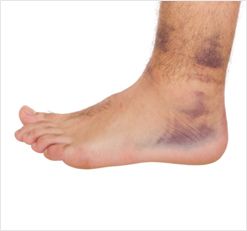
Following an ankle sprain, some individuals may experience swelling, bruising, stiffness, and discomfort with walking or standing, with temporary support such as strapping, crutches, or a walking boot sometimes required. In more significant injuries, fractures may also need to be ruled out. Some people may continue to experience ankle instability, stiffness, or ongoing discomfort following an ankle sprain, including presentations associated with Sinus Tarsi Syndrome.
Our ankle sprain rehabilitation approach may involve the following stages of management:
Phase One:
- Early management approaches may focus on reducing swelling and supporting recovery using RICER principles.
- Rest
- Ice
- Compression
- Elevation
Phase Two:
- Approaches focused on improving ankle mobility
- Massage
- Stretching-based rehabilitation exercises
Phase Three:
- Strengthen Muscle
- Exercise-based strengthening approaches for the calf, ankle, and foot region
Phase Four:
- Assessment and management of foot posture and biomechanics
- Certain foot movement patterns, including outward or inward rolling of the foot, may contribute to ankle sprain presentations and conditions such as Sinus Tarsi Syndrome.
Phase Five:
- Rehabilitation exercises designed to support movement, balance, and sport-specific function
- Sport-specific exercises based on individual movement requirements
Ankle Rehabilitation Options Including the EXO-L Brace
For some runners and active individuals, ankle sprains may lead to ongoing ankle instability or difficulty returning to activity. The EXO-L ankle brace is a custom 3D-printed support designed to provide additional ankle support during movement while maintaining comfort and day-to-day mobility. At SA Running Injury Clinic, the brace may be considered as part of an ankle rehabilitation and support program.
Supportive Foot and Ankle Management Options
Customised through a 3D scanning and printing process, the EXO-L brace is designed to provide personalised ankle support during activity and movement. Its lightweight design is commonly used by runners and active individuals participating in sport or exercise. In some cases, the brace may be claimable through private health insurance under podiatry orthotic cover. Rehabilitation approaches at SA Running Injury Clinic may additionally include gait retraining, strengthening programs, and footwear assessment to support return to activity.
Sprained Ankle Assessment and Rehabilitation at SA Running Injury Clinic

SA Running Injury Clinic offers ankle sprain care in Adelaide for people living in surrounding locations such as North Adelaide, Eastwood, Walkerville, Unley, Prospect, St Peters, Glenside, Parkside, Norwood, Burnside, Brompton, Thebarton, Mile End, Fullarton, Myrtle Bank, Glenunga and Highgate.
Appointments at SA Running Injury Clinic can be arranged online or by phone across our two clinics.